
What a Formula 1 crew and a children’s hospital can teach us about work design
Photo: “2012 Italian GP – Ferrari pit” by Francesco Crippa, Wikimedia Commons, CC BY 2.0 (resized)
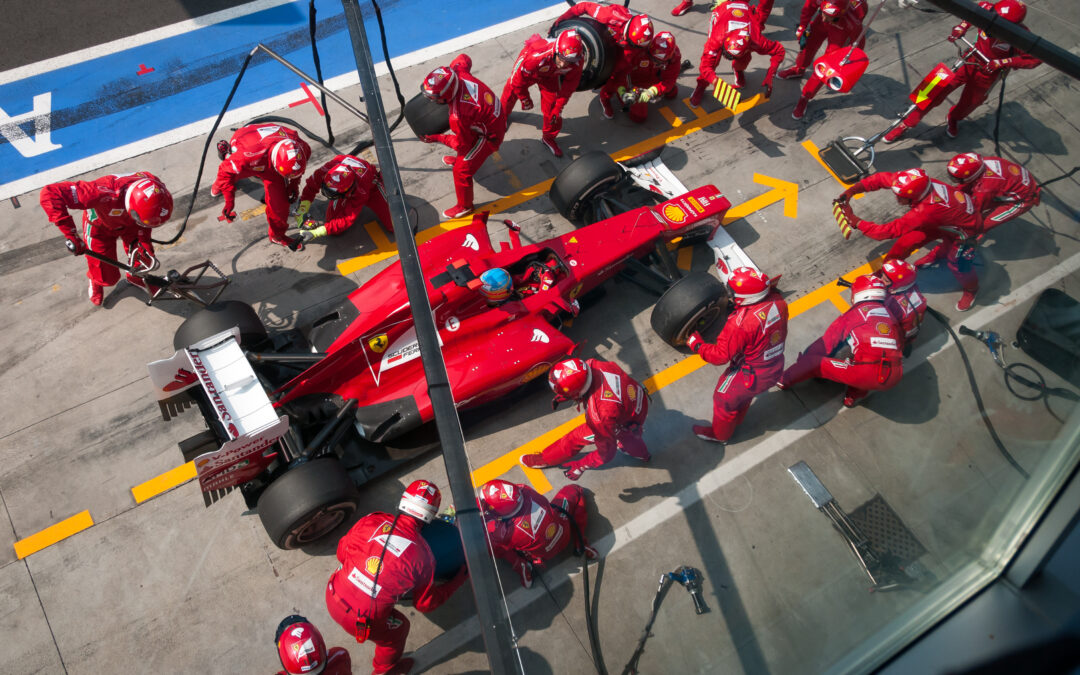
In one second, two seconds, perhaps a fraction more, a Formula 1 pit crew changes all four tyres on a car, a feat that’s impossibly slick and vital to the success of the team.
What if that amazing system became a model for your business? How do they achieve that magical process where you can hardly see the individual movements? The team functions as one entity while the process simply flows.
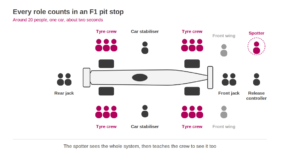
Look closely at a pit stop and you’ll see the ‘spotter’, someone who appears to be doing nothing at all yet is absolutely vital to future success, because that person knows every step of the process intimately and can see when milliseconds are lost.
The fast car is king and the driver gets the kudos, while the team makes it happen because their systems are so well designed.
From the pit stop to the operating theatre
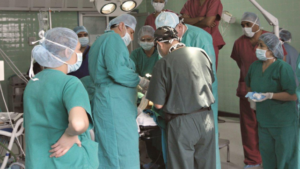
The room was wowed when Dom Thurbon told the story of paediatric cardiac surgeon Professor Martin Elliott, not just because of the many lives he saved but because of his ‘Ah ha’ moment when he likened an operating theatre to a Formula 1 team in the pits, surrounding a car that needs ‘treatment’.
Photo: RDNE Stock Project, Pexels
Babies at London’s Great Ormond Street Hospital were too often in trouble during the transfer to intensive care, so Martin turned to the Ferrari team to help work out why. Long story short, the problem fell back on the team: the culture surrounding a senior surgeon had stifled the complaints that might have provided insights, because there was no psychological safety to raise them. Ferrari were scathing, pointing out that their own success was founded on truth.1
The redesigned handover that followed made a measurable difference, with technical errors falling from an average of 5.42 per handover to 3.15, while omissions of information almost halved, from 2.09 to 1.07.2
Nothing about the doctors’ skill had changed; the difference came from how the work was designed and whether people felt safe to speak up.
This really resonated with me, because it’s a powerful reminder that we need to fix systems, not people.
What this means for your workplace
If you want your team to be at the top of their game, it’s time to look at the systems that help them to be ‘in the flow’:
- clear work design pathways that still acknowledge the need for flexibility
- a curated employee journey, from the wording of the job ad through to ongoing mentoring and the appraisal, so that growth is a slick, productive process rather than something left to chance
- a ‘spotter’ who sees the whole system, noticing what’s slowing the team down without judgement and teaching others to notice it too
When I work with a team, I take on the spotter’s role as facilitator, then teach people to take it over themselves, so the system keeps running smoothly long after I’ve stepped back.
When I’ve used the F1 model in my presentations, I’ve watched the ‘Ah ha’ moment arrive for lots of people in the room. There’s a recognition that underpinning success is the care and attention given to the systems that carry everyone through the working day.
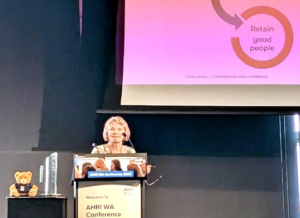
Presenting at the AHRI WA Conference 2026
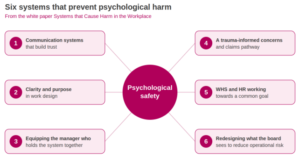
Six systems that prevent psychological harm
My white paper, Systems that Cause Harm in the Workplace: How to Redesign them for Psychological Safety, draws on 22 interviews and four case studies, including my own pilot study, to pinpoint six systems that, working together, can prevent psychological harm.
Who’s your spotter?
A pit stop doesn’t happen by accident, since hours of design, practice and review sit behind every two seconds on the track. The same is true at work, where the systems your people rely on every day will either carry them through or quietly wear them down.
Who in your team can see the whole system, and is it safe for them to say what they notice?
If you’d like to explore the six systems in more depth, the executive summary of my white paper is a great place to start.
Get your Free Executive SummarySources
- Dom Thurbon, To Be Honest… (Major Street Publishing, 2026). Story used with permission.
- K. Catchpole et al., ‘Patient handover from surgery to intensive care: using Formula 1 pit-stop and aviation models to improve safety and quality’, Paediatric Anaesthesia, 2007, vol. 17, no. 5, pp. 470-478.
Cover photo: “2012 Italian GP – Ferrari pit” by Francesco Crippa, via Wikimedia Commons, licensed under CC BY 2.0 (creativecommons.org/licenses/by/2.0). Image resized.
Operating theatre photo: Dave Garcia, Pexels. Hospital team photo: RDNE Stock Project, Pexels.